https://en.wikipedia.org/wiki/Days_for_Girls
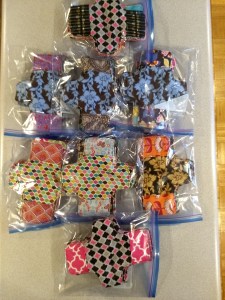
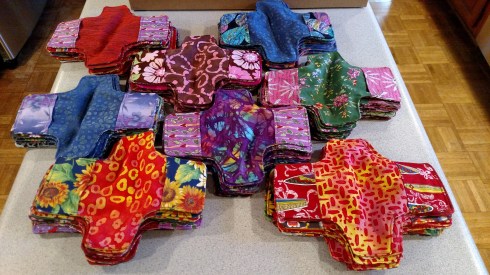
40 shields plus 160 flannel pads delivered to local chapter of Days for Girls International to be kitted in a fabric drawstring bag with panties, washcloth, soap, ziplock freezer bags and instructions.
https://en.wikipedia.org/wiki/Days_for_Girls
40 shields plus 160 flannel pads delivered to local chapter of Days for Girls International to be kitted in a fabric drawstring bag with panties, washcloth, soap, ziplock freezer bags and instructions.
Over the past 5 years I posted about sewing for Days for Girls International 28 times. What’s new? Last year I had the opportunity to change my shipments/deliveries to a new local team led by a long time friend. My work flow shifted as best described in Wikipedia as:
Lean manufacturing or lean production, often simply “lean“, is a systematic method for waste minimization (“Muda“) within a manufacturing system without sacrificing productivity, which can cause problems. Lean also takes into account waste created through overburden (“Muri“) and waste created through unevenness in work loads (“Mura“).
There is a second approach to lean manufacturing, which is promoted by Toyota, called The Toyota Way, in which the focus is upon improving the “flow” or smoothness of work, thereby steadily eliminating mura (“unevenness”) through the system and not upon ‘waste reduction’ per se. Techniques to improve flow include production leveling, “pull” production (by means of kanban) and the Heijunka box.
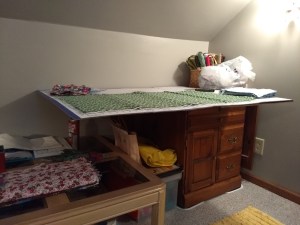
My emphasis has been on “improving workflow” in my attic sewing room.
My usual shipments to Iowa supported 40 kits with 10 items for each kit (Total=400).
With local delivery, I shifted to supporting 10 kits at a time (10 items for each kit/Total=100).
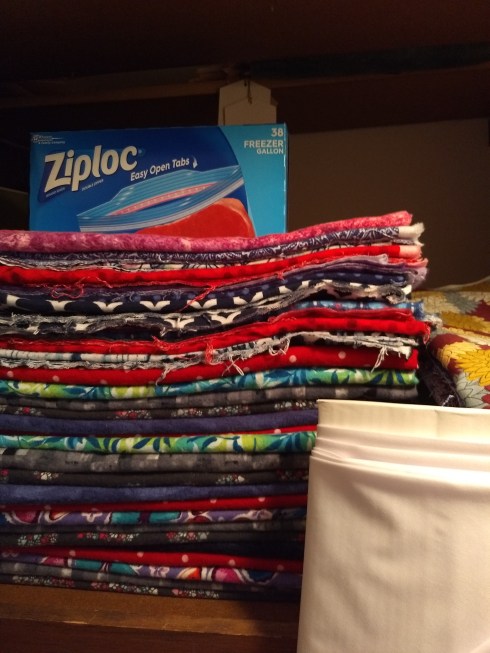
Although I still buy flannel 32 yards at time, 8 different colors/patterns 4 yards each…(this facilitates washing/drying impacting shrinkage)…which I cut into one yard lengths, which makes 10 flannel pads, which is very manageable and are placed in freezer gallon ziplock bags, which makes for easy counting and the ziplock bags are then provided in the finished DfGI kits.
I sew 80 flannel pads with 8 different colors/patterns combined into 10 ziplock bags. Then I make 20 liners with PUL, pockets and wings in 2 different color/pattern combinations (10 each in ziplock bags), which are delivered LOCALLY to be completed as 10 Days for Girls International Kits.
Local chapters pack sewn pads and liners with panties, wash cloth, soap, instructions in a sewn drawstring bag with the DfGI logo for delivery around the world. It is not just about sewing! Local chapters are encouraged to make deliveries. Our chapter delivered 50 DfGI kits to Haiti December 2018!
This is year 5 sewing for Days for Girls International. Until this summer I shipped my homemade contribution to teams working in other states…Washington and Iowa (from Indiana).
July I received emails from Kay in Iowa saying she noticed a New Team start up in my home town. Better than that…when she gave me the name…I said, “I know HER! I already have her cell number.” I did not know Tammy sewed. It is delightful to have her drop by or to run over to drop off with a friendly chat.
The team she leads completes the kit which includes 2 pairs of panties, wash cloth, etc in a drawstring bag. For more information:
Kits are designed to last three years. They have been delivered to girls in over 100 countries.
In my post “Seven Global Concepts”, a fellow blogger explained Kaizen as a Japanese concept for continuous improvement. DfGI or Days for Girls International grew their global influence by embracing Kaizen. Their website explains their 25+ design revisions developing their reusable feminine hygiene kits.
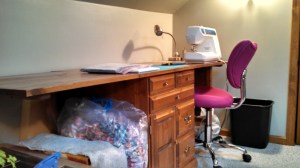
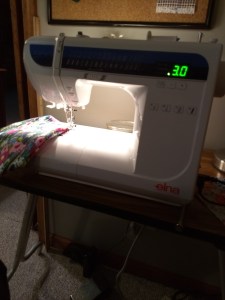
On a local level, Elfcroft applied Kaizen to the sewing room. My cabinet with two drop leaves spans almost seven feet (great for curtain projects, etc. not so great for hundreds of DfGI items per year). I noticed that working on DfGI kits would be easier if the machine was several inches lower. No height adjustment is available in the machine or table. I had the opportunity to move the machine to a sturdy, small folding table….and did just that! The sewing cabinet is working as the cutting table (with one leaf down). So far, so GOOD 🙂
Eve helps me prepare Elfcroft’s eleventh shipment of
feminine hygiene pads and shields for Days for Girls International kits.
January begins year five of our support.
We ship to chapters based in DesMoines Iowa for assembly and distribution globally.
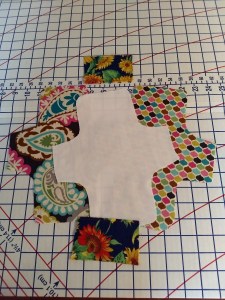
Here is a quick look at 160 shields in process (supporting 80 kits)…
Shields have five pieces: Four from cotton prints and one PUL or polyurethane laminate.
Two pieces of the cotton print make the front at back of the shield (for maximum interest I choose different prints).
The other two pieces of cotton print are for “pockets”. They are folded and topstitched before assembly.
If it is not obvious, this is a LOT of cutting and ironing.
Here I sew again, preparing to ship in 2018.
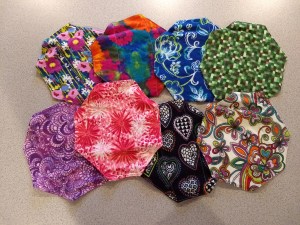
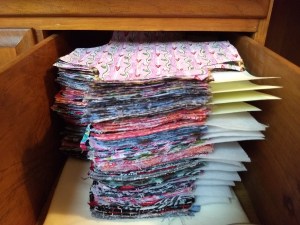
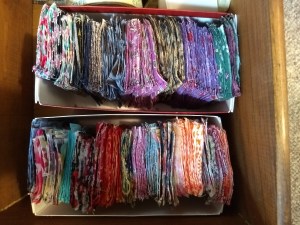
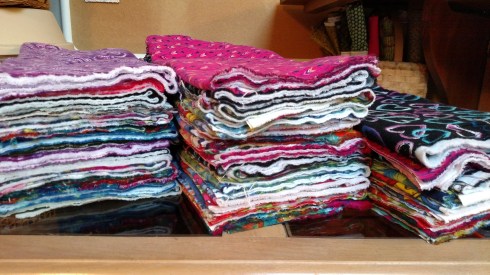
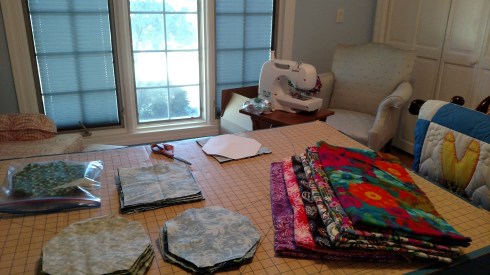
It takes 320 tri-fold, reversible, topstitched flannel pads to support 40 Days for Girls International feminine hygiene kits. One yard of 40″ wide flannel makes 10 pads. The cadence I use is to buy 32 yards in 4.25 yard lengths (9″ or 6% shrinkage) of 8 different colors/patterns to maximize variety in each kit. I wash and dry two pieces of flannel at a time (dryer filter gets heavily loaded). Then, I cut each net 4 yard length into (4) one yard pieces stacking and alternating colors/patterns in groups of eight. Shown above. The two stacks on the left make 160 pads. The short stack is my work in progress.
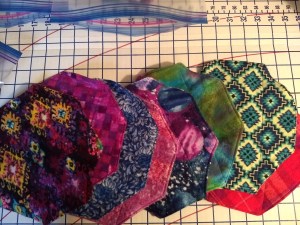
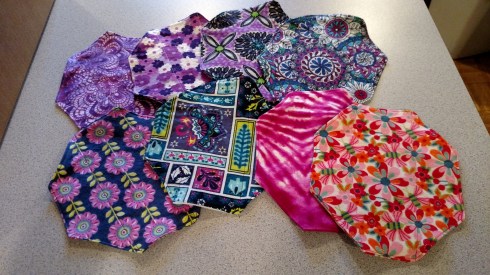
I cut (20) 8″X9″ pieces from each yard, put right sides together, miter the corners (for octagonal shape) before sewing, turning and topstitching. The double layer, tri-fold design means there are six layers which fit in the mating shield with double pockets, wings and PUL (polyurethane laminate).
Upstairs set up…great in the winter
Downstairs set up…great in the summer
Amazon “Deal of the Day” for my new Brother CS6000i gave me the opportunity to set up a sewing station at my home away from home to sew more reversible, tri-fold, top-stitched flannel pads for Days for Girls International…and whatever Mom may come up with 😉
For more information on the extraordinary work of Days for Girls International:
Elfcroft’s last shipment was divided between church, university and women’s groups to be delivered to Ghana, Guatemala and Uganda as complete kits. Pads and liners are the most labor intensive items.
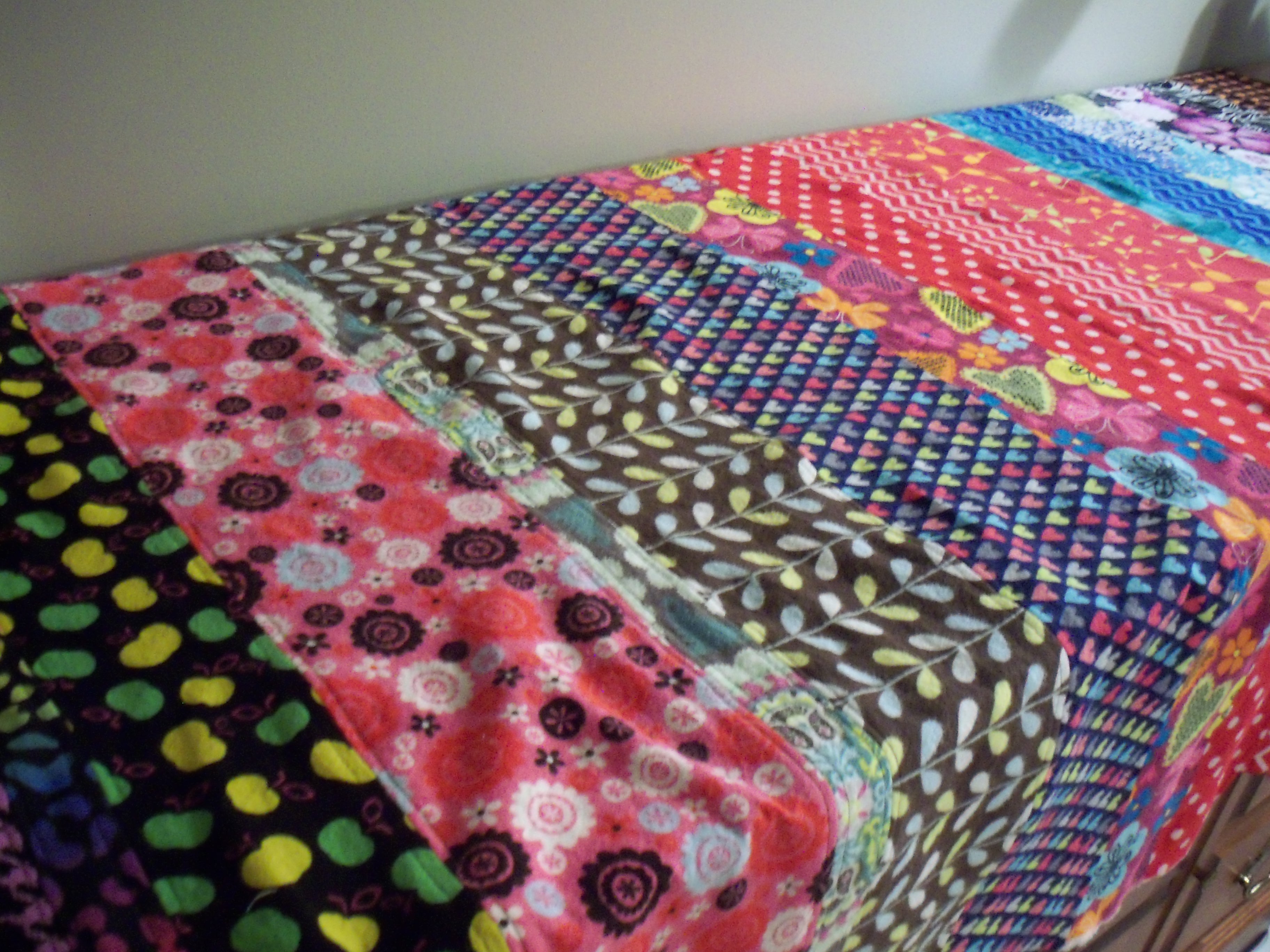
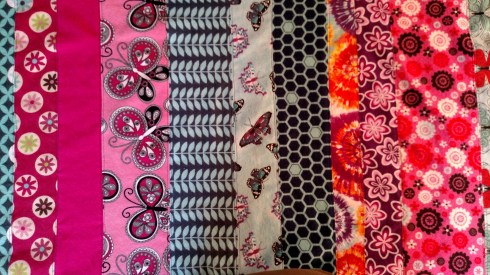
2014, I purchased flannel fabric in one to three yard lengths. Each Days for Girls International kit includes 8 reversible, tri-fold, flannel pads. My strategy included sewing pads from 8 different colors and patterns for each kit. By year-end, I had over 30 types of remnants. Variation due to cutting, shrinking from washing and fabric width created a significant amount of remnants in strips and block shapes. I recycled these scraps into two light weight blankets.
In the three years since the original post, I tightened my strategy on purchasing flannel to reduce the waste (given my experience with shrinkage and end of bolt pieces). The most significant change was to buy 4.5 yard lengths. My 2017 striped flannel piece represents is a reduction of over 75% scrap.